A botched San Diego driveway isn't just an eyesore. It's a $15,000 mistake. Most driveway projects that go wrong overrun their budget by thirty percent and their timeline by six weeks, all because of seven predictable, avoidable errors made before the first paver is laid. The homeowners who get it right don't get lucky. They get methodical.
In a Nutshell
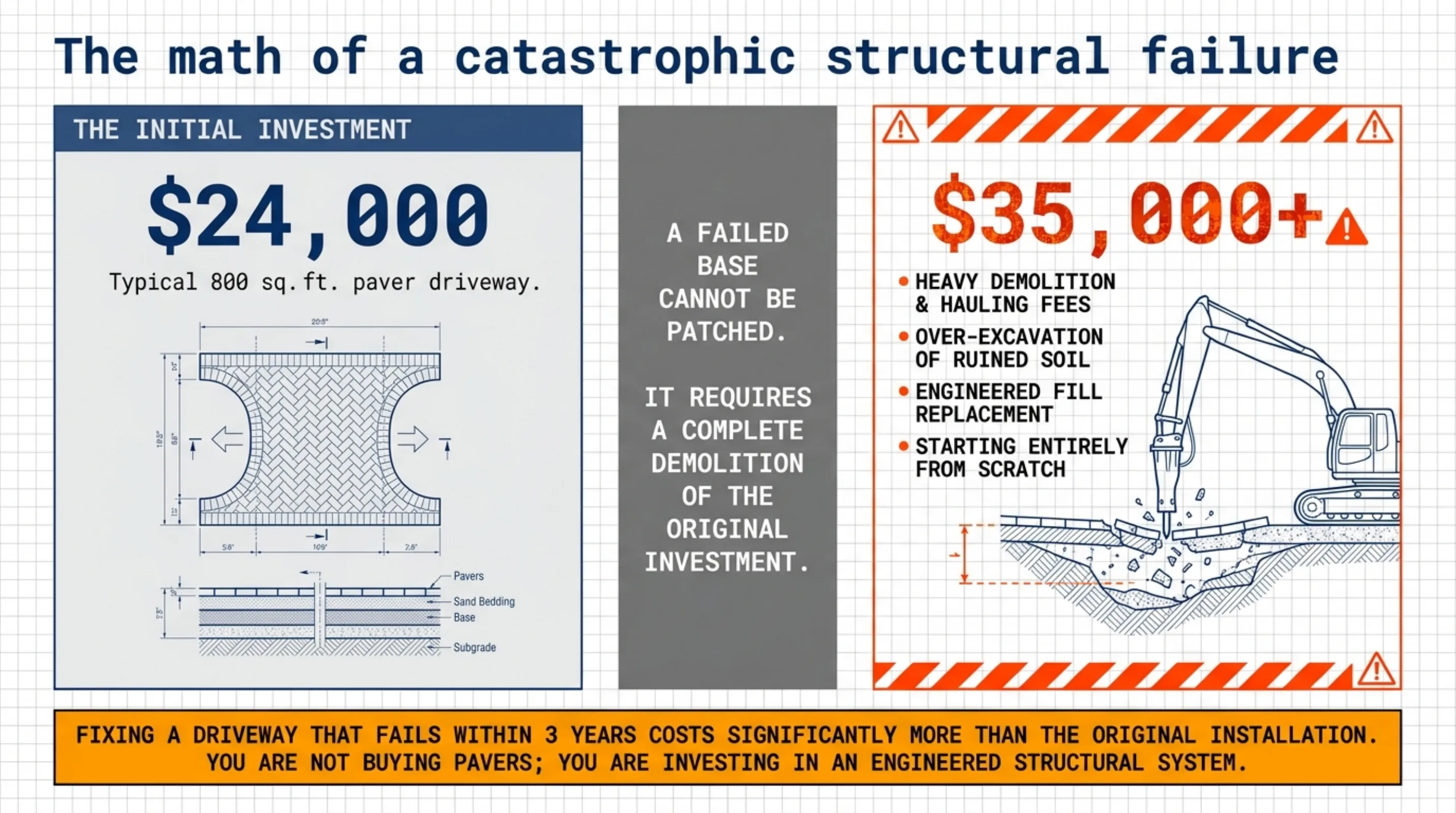
The single biggest mistake is underestimating San Diego's unique environmental challenges. Fixing a driveway that fails within three years often costs more than the original installation because of the extensive demolition and removal required. The path to failure is paved with good intentions but bad specifications.
- The Cost-of-Mistake Pattern: A typical 800-square-foot paver driveway costs around $24,000 in 2026. A premature failure due to a faulty base requires a full tear-out and replacement, costing upwards of $35,000 and wasting months.
- Three Most Common Mistakes: 1. Ignoring San Diego’s expansive clay soil, leading to cracks and heaving. 2. Choosing materials that can't withstand coastal salt spray, causing spalling and discoloration. 3. Accepting a vague, one-line quote that leaves you exposed to endless change orders.
- One Counter-Move This Week: Before you talk to a single contractor, spend $500 on a basic geotechnical soil report. This one document dictates the correct base preparation for your specific property and becomes non-negotiable use in your contract.
Mistake #1: Ignoring San Diego's Expansive Clay Soil
Most homeowners assume a driveway's foundation is standard everywhere. They allow a contractor to install a minimal four-inch gravel base, believing it's sufficient. This is a catastrophic error in many parts of San Diego County. The region, particularly in areas like Scripps Ranch, Carmel Valley, and inland communities, is known for its highly expansive clay soils. This soil acts like a sponge, swelling dramatically when saturated during winter rains and shrinking during dry summers, creating powerful ground movement. A standard base offers no resistance. The result is a driveway that cracks, heaves, and becomes uneven within two to three years. The fix isn't a patch job. It's a complete demolition and rebuild, costing you the entire project budget over again, easily $15,000 to $25,000 down the drain. The correct approach is to treat the base as an engineered system. A soil report will determine the necessary design, but the fix always involves more solid preparation. Insist that your contract specifies a sub-base of at least six to eight inches of compacted Class II aggregate base. For lots with highly plastic soil, a geotextile stabilization fabric laid between the native soil and the aggregate base may be required. This fabric prevents the clay from working its way into the base rock, maintaining structural integrity. It adds cost upfront but prevents total failure later.
Mistake #2: Underestimating Coastal Salt and Humidity
Homeowners select pavers or concrete finishes based on photos they see online, not on how those materials perform within a mile of the Pacific. They choose porous, unsealed pavers or a standard 3,000 PSI concrete mix because it's cheaper. This is a short-sighted decision in coastal San Diego. The persistent salt-laden air, from La Jolla down to Imperial Beach, is relentlessly corrosive. Salt spray accelerates a process called spalling, where the surface of concrete flakes and pits. On pavers, it contributes to efflorescence, a stubborn white powdery residue that constantly reappears. The moisture also promotes mold and algae growth, especially on the shaded north side of a property. Within a few years, a beautiful new driveway looks stained, pitted, and old. The remedy involves expensive, high-pressure chemical cleaning and sealing, a recurring cost of over $2,000 every few years, or a premature replacement. The counter-move is to specify marine-grade materials from the start. For concrete, demand a high-strength mix (minimum 4,000 PSI) with a low water-to-cement ratio and air entrainment to resist freeze-thaw cycles (even in mild San Diego). For pavers, select dense, low-absorption products from manufacturers like Belgard or Angelus. Most importantly, your contract must specify the application of a high-quality, penetrating sealer (a silane/siloxane type) immediately after installation and curing. This creates an invisible barrier against salt and water intrusion.
Mistake #3: Treating Drainage as an Afterthought
The focus is almost always on the visible surface, the color, the pattern. Drainage is treated as something that will just happen on its own. Homeowners accept a plan without any specific details on grading or water management. This is a recipe for disaster. Improper drainage is one of the fastest ways to destroy a driveway and damage your home. Water that pools on the surface will eventually work its way into the sub-base, saturating it and causing it to fail. Worse, water that flows back toward your house can flood your garage and compromise your foundation, leading to tens of thousands of dollars in damage. San Diego's weather pattern of long dry spells followed by intense, short-duration downpours makes proper drainage critical. A driveway that seems fine for ten months can fail catastrophically after one atmospheric river event. The fix is always more expensive after the fact, involving retrofitting channel drains for $3,000 or installing complex French drain systems for over $7,000. The correct approach is to demand a detailed drainage plan as part of the initial design. Your contract must specify a minimum slope of one-quarter inch per vertical foot away from any structures. For properties on tricky lots, common in hillside communities like Point Loma, a simple slope may not be enough. The plan should include solutions like channel drains installed in front of the garage, strategically placed catch basins, or the use of permeable pavers that allow water to percolate directly into a specially prepared sub-base.
Mistake #4: Getting Vague, One-Line Quotes
Most homeowners, trying to compare bids, focus on the single bottom-line price. They accept a quote that says something like, "Install new paver driveway, 800 sq. ft. - $22,000." This is the single most dangerous document in a renovation. A vague quote is not a fixed price; it is a starting point for a flood of change orders and surprise costs. It protects the contractor, not you. It deliberately omits the critical details that determine the quality and longevity of the work. What is the exact depth of the excavation? What type of base rock will be used? How thick will it be compacted? What is the specific manufacturer, style, and color of the paver? What type of edge restraint will be used to prevent pavers from shifting? Will they use cheap sand or premium polymeric sand for the joints? What brand and type of sealer is included? Each of these unanswered questions is a potential point of failure and a future expense. The correct method is to refuse to consider any bid that is not fully itemized. Your job is to create a detailed scope of work and have contractors bid on that exact scope. This is the only way to compare apples to apples. Get three quotes. Check three references. Visit one finished job before signing. A professional bid will break down costs for demolition, disposal, excavation, base materials, labor, pavers, sand, sealer, and cleanup. For a detailed guide on what to include in your scope, see Renology's San Diego Driveways Permit Playbook for 2026.
Mistake #5: Neglecting the Permit and Inspection Process
3 San Diego driveway contractors, editor-screened. 4 questions.
See my 3 matchesThe assumption is that a driveway is simple surface work, a cosmetic upgrade not requiring city oversight. Many homeowners trust a contractor who says, "We can save time and money by skipping the permit." This is terrible advice that exposes you to significant financial and legal risk. The City of San Diego Development Services Department requires permits for most new driveways or replacements, especially when the work involves altering a curb, changing the grade, or impacting public right-of-way drainage. A permit is not just bureaucracy. It triggers inspections that verify the work meets minimum safety and construction standards. Working without a required permit can lead to a stop-work order from a city inspector, which halts your project indefinitely. You may then be subject to fines, penalties, and be required to pay for retroactive permits. In the worst-case scenario, if the unpermitted work is found to be substandard, the city can order you to tear it all out and start over at your own expense. The contractor who suggested skipping the permit will be long gone. Protect yourself by doing your own due diligence. Call the city's building department to confirm the requirements for your specific project. Your contract must explicitly state that the contractor is responsible for securing all necessary permits and scheduling all required inspections. Do not make the final payment until you have a copy of the passed final inspection report from the city.
Mistake #6: Choosing the Wrong Contractor for the Material
A driveway is a driveway, right? A contractor who does hardscaping can handle concrete, pavers, or asphalt equally well. This is a common and costly misconception. Homeowners often hire a generalist because their price is competitive, not realizing that different driveway materials require highly specialized skills and equipment. Decorative stamped concrete, for example, is an art form. It requires deep knowledge of concrete mix designs, color hardeners, releasing agents, and precise timing to apply the stamps before the concrete sets. A novice can easily leave a blotchy, uneven, and cracked surface. Permeable paver systems are not just pavers with bigger gaps; they are complex drainage systems that require specific training in multi-layered base construction and excavation. An installer without certification can inadvertently create a subsurface bathtub that holds water instead of dispersing it. The consequences of hiring the wrong specialist are dire: the material manufacturer's warranty is often voided, and the only fix for a failed installation is a full replacement. The counter-move is to vet your contractor for the specific material you have chosen. For pavers, ask for their Interlocking Concrete Pavement Institute (ICPI) certification. For concrete work, ask if they have American Concrete Institute (ACI) certified finishers on their crew. For any specialized system, demand to see a portfolio of at least three similar local projects that are more than two years old. Call those references and ask how the installation has held up.
Mistake #7: Skimping on the Base Preparation
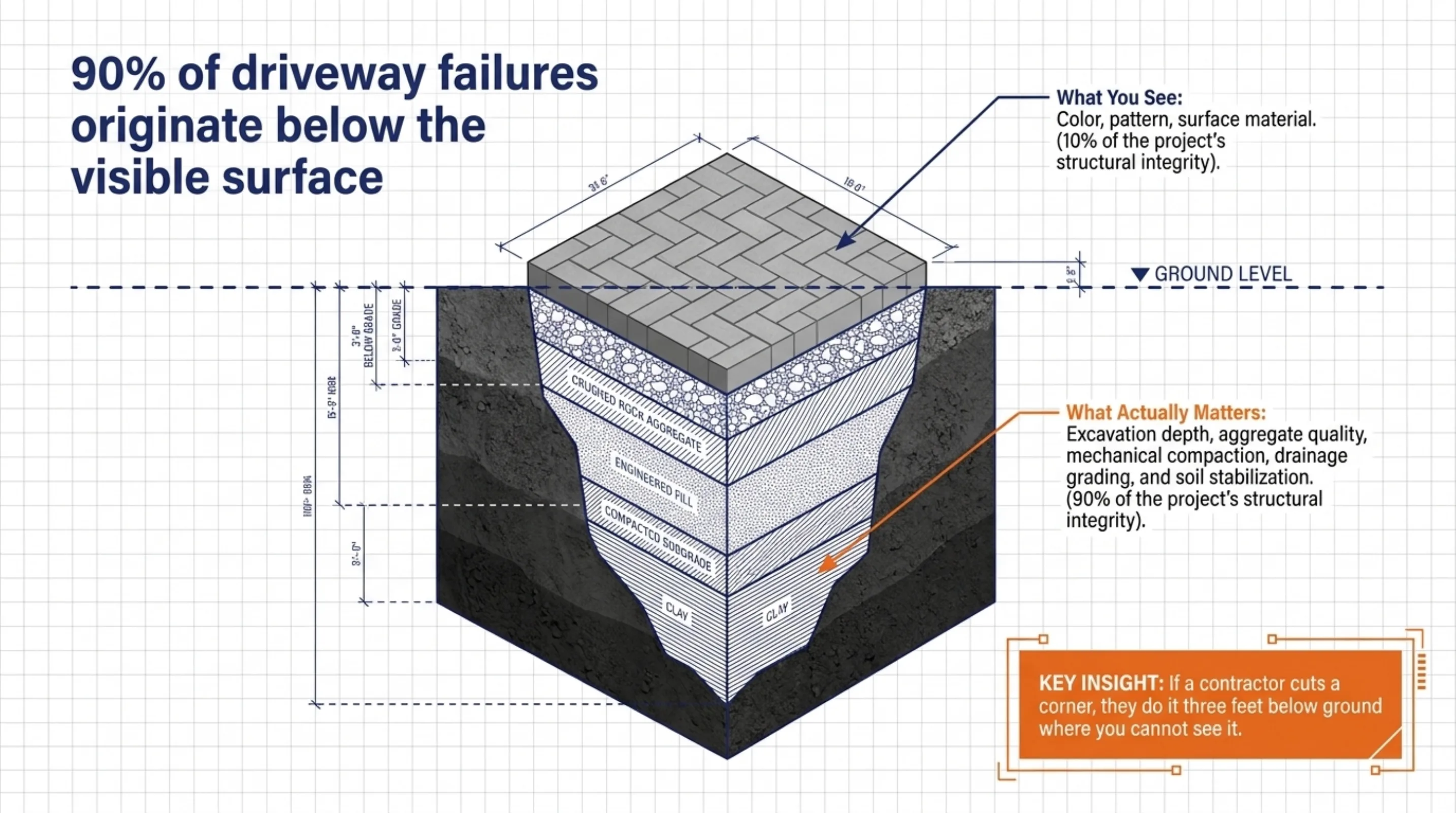
This is the cardinal sin of driveway installation, and it happens on job sites every day. To save a day of labor or cut material costs, a contractor will rush the most critical part of the project: the foundation. They will excavate too shallow, use poor-quality fill dirt instead of proper aggregate, or fail to compact the base adequately. The homeowner, focused on the top layer of beautiful pavers, never sees the corner being cut three feet below. This is where ninety percent of driveway failures originate. The base is what distributes the load of vehicles and resists movement from the underlying soil. A weak or improperly compacted base will inevitably lead to sagging, rutting, and shifting pavers, often within the first 18 to 24 months. You will see depressions where your car tires sit every day. The pavers will become uneven, creating trip hazards. The entire investment is lost because the part you cannot see was done incorrectly. The only solution is to tear everything out and start again, doubling the project's cost. To prevent this, your contract must be ruthlessly specific about the base. It should mandate the excavation depth (minimum six inches for stable soils, eight inches or more for expansive clay), the exact material to be used (e.g., Caltrans Class II aggregate base), and the compaction method. The base must be installed in "lifts" (layers) of no more than four inches at a time, with each lift being mechanically compacted to 95 percent of its potential density. Be present during this phase of the work. If you see workers dumping six inches of gravel at once and running a small plate compactor over it for ten minutes, they are not following protocol. A proper base takes time, effort, and the right equipment.
What no one else covers: The 10-Year Color and Finish Test
Most articles on driveway mistakes focus on structural failure, the cracks and sinking that are impossible to ignore. But aesthetic failure is just as costly and frustrating. As a finish specialist, I see homeowners spend $30,000 on a new driveway only to hate how it looks in five years. This is completely avoidable by thinking about long-term material performance in the intense San Diego sun. The UV radiation here is unforgiving. It will fade low-quality color pigments in concrete and pavers, turning a rich charcoal into a washed-out gray. When choosing colors, ask the manufacturer for data on UV stability. Products like James Hardie ColorPlus for siding have baked-on finishes for a reason; your driveway sealer should have similar UV-blocking properties. Darker-colored driveways, popular for modern homes, create a significant heat island effect. A black paver driveway in a hot inland area like Santee or El Cajon can become too hot to walk on barefoot and will radiate heat back at your home, increasing cooling costs. Lighter colors compliant with cool roof standards can make a measurable difference. Finally, the choice of sealer is paramount. Most contractors will use a cheap, acrylic-based "wet look" sealer. It looks great for six months, then begins to yellow, peel, and flake under the sun. This requires costly and toxic chemical stripping to remove before a new coat can be applied. The professional's choice is a high-quality, penetrating silane/siloxane sealer. It soaks into the concrete or paver, creating an invisible, water-repellent barrier from within. It does not change the surface appearance, does not get slippery, and lasts five to seven years before needing a simple reapplication, with no stripping required.
Three Representative Driveway Cost in San Diego Scenarios (2026)
Three modeled project scenarios for 2026, built from the Renology Cost Index and typical local scopes. These are illustrative estimates, not completed client projects:
- $9,500: Basic Concrete Replacement (Normal Heights). For a 500-square-foot driveway, this project involved demolishing and hauling away the existing cracked concrete. The contractor formed and poured a new four-inch slab using a standard 3,500 PSI mix with a classic broom finish for traction. This price reflects straightforward site access and stable soil conditions, requiring minimal base work.
- $26,000: Mid-Range Paver Installation (Carlsbad). This 800-square-foot project used popular Belgard Catalina Grana pavers. The cost included significant excavation to create a proper six-inch compacted base to handle the area's soil, installation of polymeric sand in the joints, a channel drain at the garage entrance to manage water runoff, and a high-quality penetrating sealer.
- $48,000: High-End Permeable Paver System (Rancho Santa Fe). On a 1,200-square-foot driveway, this homeowner opted for a stormwater-compliant permeable paver system. The high cost reflects the extensive excavation required for the 12-inch multi-layered base of various-sized aggregates, which acts as a retention basin. This price also includes the specialized labor and equipment needed for this type of environmentally friendly installation.
These figures represent typical all-in costs for a complete project. Smaller projects, such as a simple repair or a driveway for a condo or townhome, can start lower.
Understanding Driveway Cost Drivers in San Diego
Several factors make driveway installation a significant investment in the San Diego area. Labor is a primary component. According to the California Department of Industrial Relations prevailing wage data for San Diego County, skilled construction labor rates are among the highest in the nation. This ensures you are paying for qualified professionals but adds a premium to the overall cost. Material choice is another major variable. A standard poured concrete driveway is the most budget-friendly option, while high-end natural stone or permeable pavers can cost three to four times as much per square foot. Demolition and disposal of the old driveway are also significant line items; San Diego has strict regulations and high fees for disposing of concrete and asphalt. Site-specific challenges can escalate costs quickly. A steeply sloped lot requires more complex grading and drainage engineering. Poor soil conditions, like the expansive clay common in the region, necessitate a much deeper, engineered sub-base, adding thousands in material and labor costs. The National Association of Home Builders recommends a ten to fifteen percent contingency on renovations in homes over thirty years old. For driveway projects, this contingency is critical for dealing with unforeseen underground issues like buried utility lines or poor soil once excavation begins.
Sources & Methodology
See the Renology Methodology for how sources are reviewed, ranges are normalized, and planning-data limits are handled.
Cost ranges in this guide draw on the following named industry sources, public agency datasets, and Renology editorial research.
- California Department of Industrial Relations, Prevailing Wage Determinations (2026)
- Interlocking Concrete Pavement Institute (ICPI), Tech Spec Library (2025)
- American Concrete Institute (ACI), Residential Concrete Guidelines (2025)
- City of San Diego Development Services Department, Information Bulletin 121 (2025)
- Remodeling Magazine, Cost vs. Value Report (2026)
- National Association of Home Builders (NAHB), Home Building Geography Index (Q1 2026)
- U.S. Census Bureau, Monthly Construction Spending Report (2026)
- Belgard Hardscapes, Coastal Installation Best Practices (2026)
- Angelus Paving Stones, Installation Guide for Clay Soils (2025)
- California Building Standards Code (Title 24), Part 2: California Building Code (2025)
- Portland Cement Association, Concrete Technology Resources (2026)
Renology Take
The meta-mistake behind almost every failed driveway project is impatience. Homeowners are eager to see the finished product and rush through the most critical phase: planning and contractor vetting. They skip the soil report, accept vague quotes, and don't check references because they want the work to start tomorrow. This haste is what costs you thousands. The decisions made in the two weeks before a contract is signed have more impact on the project's success and final cost than all the work that follows. The boring part is the part that saves you money. Slow down. Get the geotechnical report. Create a detailed scope of work. Insist on line-item bids from at least three qualified, vetted contractors. Visit their past projects. The thirty days you spend on meticulous planning will save you thirty months of regret and a $15,000 replacement bill. Don't just hire a contractor; hire a plan.
Frequently Asked Questions
What's the most expensive mistake in a San Diego driveway installation?
How do I know if my driveway contractor is cutting corners on the base?
Are permeable pavers worth the extra cost in San Diego?
How long should a new driveway last in Southern California?
What's the best driveway material for a home in a high fire risk zone like Alpine?
Can I just resurface my cracked driveway instead of replacing it?
How much does a driveway permit cost in the City of San Diego?
Why did my contractor's quote seem cheap but the final bill was high?
What is polymeric sand and why is it essential for paver driveways?
How often do I need to seal my driveway in San Diego's climate?
San Diego · pre-screened
Get 3 San Diego driveway bids in 48 hours.
Our editors already vetted San Diego driveway contractors. Answer 4 questions and we send 3 written bids inside 48 hours, with the real price for your scope, not their inflated first-call number.
- Free, no commission
- Pre-screened locally
- Bids inside 48 hours
Takes about 60 seconds. We'll text you when bids arrive.
Sources
- California Department of Industrial Relations, Prevailing Wage Determinations
- Interlocking Concrete Pavement Institute (ICPI), Tech Spec Library
- American Concrete Institute (ACI), Residential Concrete Guidelines
- City of San Diego Development Services Department, Information Bulletin 121
- Remodeling Magazine, Cost vs. Value Report
- National Association of Home Builders (NAHB), Home Building Geography Index
- U.S. Census Bureau, Monthly Construction Spending Report
- Belgard Hardscapes, Coastal Installation Best Practices
- Angelus Paving Stones, Installation Guide for Clay Soils
- California Building Standards Code (Title 24), Part 2: California Building Code
- Portland Cement Association, Concrete Technology Resources