
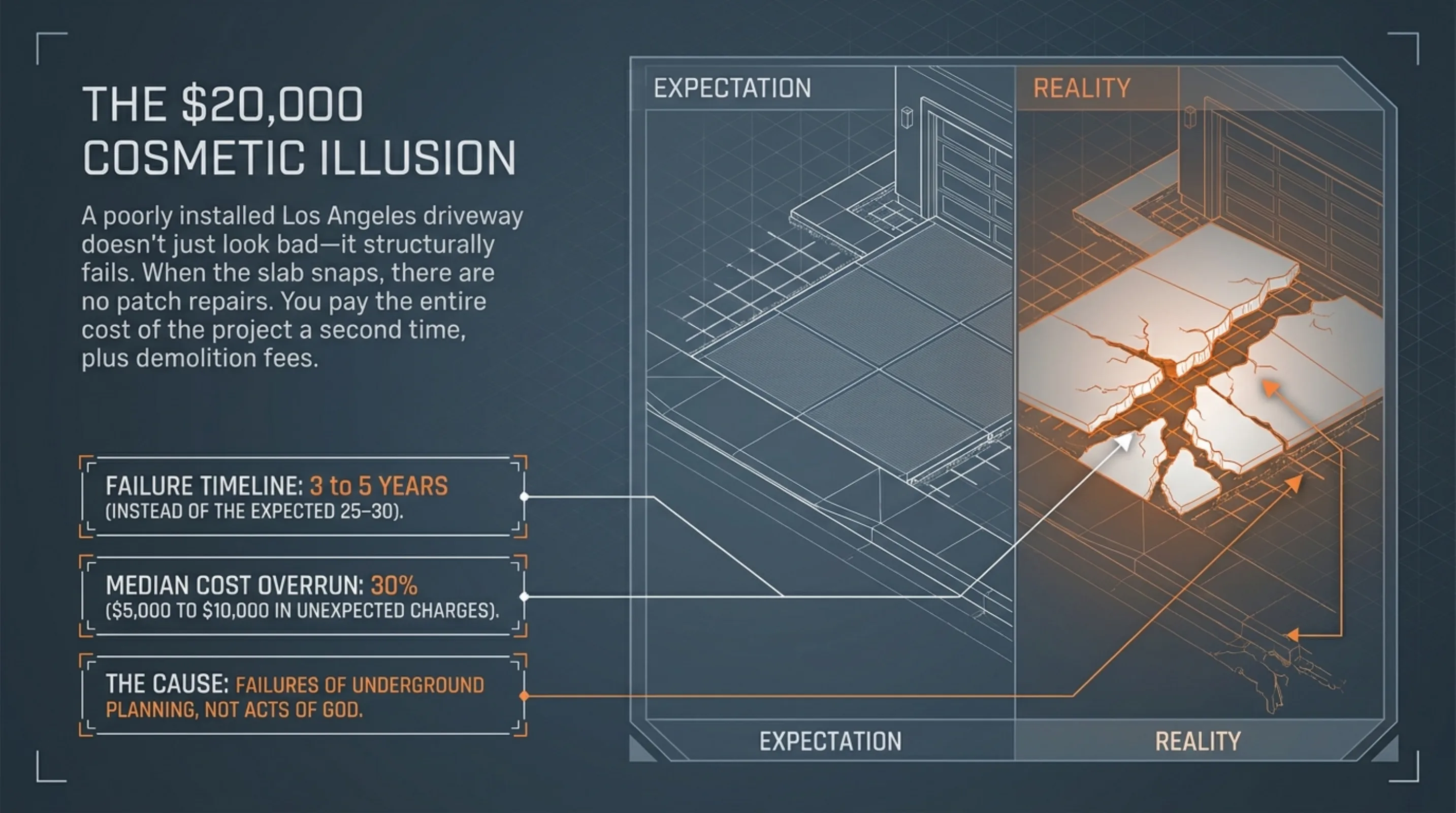
The median cost overrun I see on Los Angeles driveway projects is 30 percent, adding $5,000 to $10,000 in unexpected charges and weeks of delays. These are not acts of God. They are failures of planning. The homeowners who nail their budget for a new driveway in Los Angeles do seven things right before a single shovel hits the dirt. While a simple asphalt resurfacing project can start lower, a full replacement is a structural project with a structural price tag and plenty of room for expensive errors.
In a Nutshell: The Core Mistakes
A poorly installed driveway doesn't just look bad. It fails. In Los Angeles, that failure often happens within three to five years, not the expected twenty. The cost to fix it is 100 percent of the original price, plus demolition fees. You pay for the same project twice.
- The Three Big Failures: One, ignoring LA's expansive clay soil. Two, using a sub-base that's too thin for the soil and vehicle weight. Three, hiring a contractor based on a low bid without verifying their CSLB license, insurance, and specific hardscape portfolio.
- Your First Move This Week: Before calling a single contractor, find a local geotechnical engineer. A basic soil report for a residential site costs $500 to $1,500. This report is not a nice-to-have. It is the blueprint for a driveway that will last decades, and it's the single best investment you can make in the entire project.
Driveway Costs & Specifications at a Glance: Los Angeles 2026
Most homeowners focus on the surface material, but the long-term value of any driveway is in the structural specifications below ground. Bargain-basement quotes almost always achieve their price by cutting corners on these invisible components. Here are the non-negotiable minimums for a lasting driveway in Los Angeles.
| Specification | Common Contractor Minimum | Renology Recommendation | Why It Matters in LA |
|---|---|---|---|
| Concrete Strength (PSI) | 3,000 PSI | 4,000 PSI | Withstands heavy SUVs, delivery trucks, and provides greater resilience against cracking from minor seismic shifts. |
| Sub-Base Depth | 4 inches | 6-8 inches of compacted Class II base rock | Crucial for stability on the expansive clay soils found from the Valley to the Westside. Prevents heaving and cracking. |
| Rebar Grid Spacing | #3 rebar at 24" on-center | #4 rebar at 18" on-center | Adds critical tensile strength, holding the slab together if the underlying soil moves or settles. |
| Drainage Slope | 1% grade | 2% grade (1/4 inch per foot) | Effectively sheds water during winter storms, prevents pooling near your foundation, and helps meet municipal LID requirements. |
Mistake #1: Skipping the Geotechnical Report for LA's Expansive Soils
Most homeowners treat a driveway like a cosmetic update. They get quotes for concrete or pavers and pick a look. This is the foundational error. In Los Angeles, a driveway is a structural engineering project because the ground itself is unstable. Much of the LA basin, particularly in areas like Sherman Oaks and parts of Eagle Rock, sits on expansive clay soil. This soil acts like a sponge, swelling dramatically when wet and shrinking as it dries, exerting immense pressure on any slab above it. A standard four-inch slab of concrete on a minimal base will crack under this pressure, often within the first two years.
The fix is to treat the cause, not the symptom. A geotechnical report analyzes your specific soil composition and provides your contractor with the exact specifications needed for the sub-base depth and reinforcement. Skipping this step to save $1,000 is a classic example of being penny-wise and pound-foolish. When the driveway cracks and heaves, the only solution is a complete demolition and replacement, costing you the full price of the project a second time. A proper soil report is the cheapest insurance you can buy against a $20,000 premature failure. Insist that any bid you consider is based on the recommendations of a geotechnical engineer.
Mistake #2: Ignoring Los Angeles's Strict Stormwater Rules
Homeowners often think drainage is just about sloping the driveway away from the house. In the City of Los Angeles, it's far more complex. Due to federal and state clean water mandates, the city has a Low Impact Development (LID) ordinance that applies to many residential projects, including new or replaced driveways over a certain size. The goal is to manage stormwater on-site rather than letting it run into the street, picking up pollutants and overwhelming the storm drain system. Ignoring these rules can result in a stop-work order from a city inspector, fines, and the costly requirement to tear out non-compliant work.
The solution is to design for compliance from day one. This usually means one of two approaches. You can use permeable materials, like permeable interlocking concrete pavers (PICPs) from brands like Belgard or Angelus Block, which allow water to seep through into a specially prepared gravel base. Or, you can grade a traditional impervious driveway (like concrete or asphalt) to drain into an on-site collection system like a rain garden, bioswale, or dry well. A knowledgeable driveway contractor in Los Angeles will be familiar with the LID ordinance and can explain the best options for your property. Ask potential contractors specifically how their plan addresses on-site stormwater management. If they don't have a clear answer, they are not the right contractor for the job.
Mistake #3: Skimping on the Sub-Base Preparation
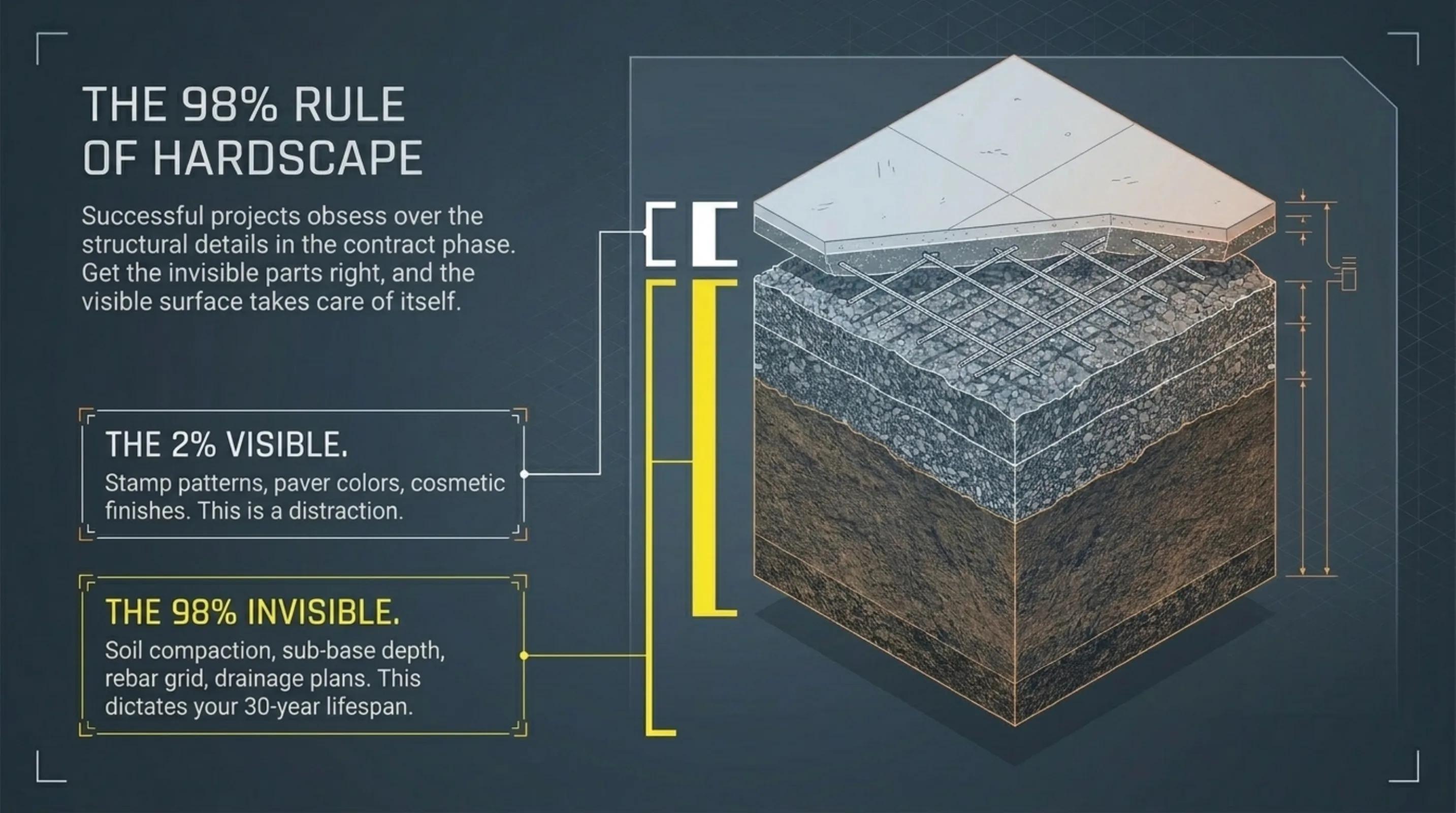
The part of your driveway you see is the least important part. The success or failure of the project depends entirely on the unseen foundation beneath it, known as the sub-base. This is a layer of compacted aggregate rock that creates a stable, load-bearing platform and facilitates drainage. Most premature driveway failures, from long, spidery cracks to sunken areas, are directly caused by an inadequate sub-base. A contractor looking to win a bid with a low price will often cut corners here, reducing the depth from the recommended six or eight inches to a mere three or four, or using inferior, poorly graded material.
This mistake can cost you everything. On LA's expansive soils, a thin sub-base offers no protection from soil movement. The slab will flex, crack, and fail. The fix is to specify the sub-base requirements in your contract. For Los Angeles driveways, a minimum of six inches of compacted Caltrans Class II aggregate base is the standard. For properties with highly expansive soil or those supporting heavy vehicles like an RV, eight inches is better. The contract should state the depth, the material type, and the compaction requirement (typically 95 percent). A good contractor will document this process with photos. Do not release final payment until you have confirmation that the sub-base was built to spec.
Mistake #4: Specifying the Wrong Concrete or Paver Base
Not all concrete is the same. Most homeowners don't know to ask about the specific mix, and many contractors will default to a cheaper, lower-strength product to pad their margins. Using a 3,000 PSI (pounds per square inch) mix for a driveway in Los Angeles is a common but costly mistake. While it might be adequate in milder climates, the combination of intense sun, occasional heavy rain, and the weight of modern SUVs demands a more solid material. Lower-strength concrete is more susceptible to surface spalling, chipping, and cracking over its lifespan.
The counter-move is to specify a minimum 4,000 PSI mix in your contract. The incremental cost for the stronger mix is minor, typically adding only a few hundred dollars to the total project cost, but it dramatically increases the durability and lifespan of the slab. For paver driveways, the equivalent mistake is an inadequate bedding sand layer. The Interlocking Concrete Pavement Institute (ICPI) specifies a uniform one-inch layer of coarse, washed concrete sand (ASTM C33). A contractor using the wrong type of sand or an inconsistent depth will create a surface where pavers shift, settle, and become uneven within months. Verify the exact materials to be used, from the concrete supplier's ticket to the sand specification, before work begins. Get it in writing.
Mistake #5: Hiring the Wrong Driveway Contractor in Los Angeles
3 Los Angeles driveway contractors, editor-screened. 4 questions.
See my 3 matchesThe single biggest risk in any home improvement project is the person you hire to build it. Los Angeles has thousands of people with a truck and some tools who call themselves a contractor. Many are uninsured, unlicensed, or lack the specific expertise for structural hardscape work. Homeowners, anxious to save money, often fall for a low bid without proper vetting. This can lead to shoddy work that fails inspection, a contractor who disappears mid-project after being paid, or even liability for injuries that occur on your property if the contractor lacks workers' compensation insurance.
The fix is a disciplined, multi-step vetting process. Do not accept a single quote. Get three quotes. Check three references for each. Visit one finished job before signing any contract. For any contractor you seriously consider, perform these three checks online: First, verify their C-8 (Concrete) or C-61 / D06 (Pavers) license is active and in good standing on the Contractors State License Board (CSLB) website. Second, ask for their certificates of general liability and workers' compensation insurance and call the insurance company to confirm the policies are current. Third, search their company name in the Los Angeles County Superior Court records online to check for a history of litigation with past clients. This process takes a few hours but can save you thousands of dollars and years of regret. A true professional will welcome this level of scrutiny.
Mistake #6: Assuming Your Driveway Doesn't Need a Permit
Many homeowners believe that replacing a driveway is a simple repair that doesn't require city approval. This is a dangerous assumption in Los Angeles. While a simple resurfacing or replacing a small section might not trigger a permit, most full replacements do. Any work that involves altering the grade, expanding the footprint, or, most critically, changing the driveway apron where it meets the street, requires a permit from the Los Angeles Department of Building and Safety (LADBS). Working without a required permit can result in a stop-work order, fines that can double the permit fee, and the potential need to tear out the completed work if it doesn't meet code.
The correct approach is to clarify the permit requirements for your specific project before you even finalize the scope with a contractor. The contractor should be responsible for pulling the permits, and this should be explicitly stated in the contract. You can find detailed information on the LADBS website, but a good starting point is our comprehensive guide, which you can find here: Los Angeles Driveways Permit Playbook 2026. A contractor who tells you a permit isn't needed for a full replacement is either ignorant of the law or intentionally cutting corners. Both are giant red flags. Make the permit a condition of the contract and do not make the final payment until the inspector has signed off on the completed work.
Mistake #7: Choosing Finishes for Curb Appeal Over UV-Resistance
In the final stages, homeowners focus on aesthetics: the stamp pattern, the color, the sealant. In the relentless Southern California sun, these choices are not just cosmetic, they are crucial for longevity. One common mistake is choosing very dark colored pavers or dark integral color for concrete. Dark surfaces absorb significantly more heat, which can accelerate the breakdown of sealants and stress the material itself. Another error is opting for a cheap, acrylic-based sealant that looks great for six months before yellowing, flaking, and offering little protection. These sealants need to be stripped and reapplied frequently, adding a significant maintenance cost over the life of the driveway.
The solution is to select materials and finishes engineered for high-UV environments. For pavers, lighter colors from manufacturers like Belgard or Orco will reflect more heat and show less apparent fading. For concrete, if you want color, consider a high-quality, UV-stable integral colorant. For sealing, the most critical step, insist on a penetrating, silane-siloxane based sealant. Products like Vulkem 45SSL or similar polyurethane sealants offer superior UV resistance and durability compared to cheaper acrylics. They cost more upfront but protect the investment for years, not months, preventing stains and water intrusion that can degrade the surface. Always check the manufacturer's specs for UV stability before approving a finish.
Information Gain: The Driveway Apron Permit Trap No One Mentions
Here is a detail that trips up even experienced contractors and costs Los Angeles homeowners weeks of delays: the driveway apron. The apron is the section of the driveway in the public right-of-way, crossing the parkway and sidewalk to meet the street. Most people assume it's covered by the main LADBS building permit. It is not. This section falls under the jurisdiction of a different city department, the Bureau of Engineering (BOE). It requires a separate A-Permit or B-Permit, which has its own application process, standards, and inspectors.
A contractor who doesn't work in the City of LA regularly may not know this. They'll build your entire driveway, then discover they can't connect it to the street without this separate permit. At this point, work stops. You have to apply to the BOE, which can take weeks, and their inspectors are notoriously strict about curb cut grades, sidewalk replacement, and even the protection of street trees. If your new apron doesn't meet their specific standards (which differ from the general building code), they will order you to tear it out and rebuild it at your own expense. I've seen this add $5,000 and a month of delays to a project that was otherwise finished. Before hiring, ask your contractor to explain their process for securing the BOE permit for the driveway approach. If they look confused, they are not qualified to do the job in the City of Los Angeles. This single piece of knowledge separates the true local pros from the rest.
How to Budget for a New Driveway in Los Angeles
A new driveway is a significant investment, with the cost for a proper installation in Los Angeles often surprising homeowners. A typical two-car concrete driveway of 600 square feet can range from $9,000 to $18,000, while pavers can run from $15,000 to $30,000 or more. Understanding the cost breakdown is key. Generally, about 50 percent of the cost is labor, 30 percent is materials, 10 percent covers permits and fees, and the remaining 10 percent is the contractor's overhead and profit. Labor is the largest component, and according to the California Department of Industrial Relations prevailing wage data for Los Angeles County, skilled concrete finishers and equipment operators command high wages. This is why a low bid is often a sign of an unskilled or uninsured workforce.
When creating your budget, you must include a contingency fund. The National Association of Home Builders recommends a ten to fifteen percent contingency on renovations in homes over thirty years old. I apply the same rule to exterior projects dealing with unknown soil and drainage conditions. For a $20,000 driveway project, this means having an extra $2,000 to $3,000 set aside for surprises, like discovering old utility lines that need to be moved or hitting a layer of rock that requires extra excavation. This fund is your protection against budget overruns and ensures you can complete the project to the right standard without cutting corners when the unexpected occurs.
Representative Driveway Projects from 2026
Three modeled project scenarios for 2026, built from the Renology Cost Index and typical local scopes. These are illustrative estimates, not completed client projects:
- Mar Vista Permeable Paver Driveway: A 750-square-foot driveway for a home near the coast. The homeowner chose Belgard Eco-Dublin pavers to comply with LID ordinances and manage runoff. The project required extensive excavation for a deep, open-graded base to act as a reservoir. Total Cost: $23,500.
- Studio City Hillside Concrete Driveway: A long, 1,100-square-foot poured concrete driveway on a sloped lot. The project involved significant grading, a new concrete block retaining wall, and extensive rebar reinforcement due to the hillside location. The finish was a simple broom finish for traction. Total Cost: $38,000.
- Highland Park Asphalt Replacement: A straightforward 600-square-foot project to remove a cracked asphalt driveway and replace it with new asphalt. This was a remove-and-replace job with minimal grading and no complex drainage work, representing the lower end of the cost spectrum for Los Angeles driveways. Total Cost: $9,200.
Renology Take
The meta-mistake behind almost every failed driveway project is focusing on the two percent you can see instead of the 98 percent you can't. Homeowners spend weeks choosing between a broom finish and a salt finish, or agonizing over paver colors. This is a distraction. A beautiful surface on a weak foundation is worthless. Your driveway's twenty-year lifespan is determined before a single drop of concrete is poured or a single paver is laid. It's determined by the soil test, the sub-base depth, the compaction quality, and the drainage plan. The most successful projects I see are led by homeowners who obsess over these structural details in the contract phase. They let the contractor know they understand that the foundation is everything. Get the invisible parts right, and the visible surface will take care of itself.
Sources & Methodology
Renology reviews public permit and labor signals, supplier pricing, remodeler quote patterns, comparable projects, the Renology Cost Index, and the Renology Methodology. Cost references are planning ranges for Los Angeles driveway projects, not fixed bids.
This article is from The Renology Magazine, the renovation magazine and contractor-advisory for homeowners in Southern California, San Diego, and Greater Seattle. Want more renovation breakdowns? Search "The Renology Magazine" on Google.
Frequently Asked Questions
What's the most expensive driveway mistake in Los Angeles?
How do I know if a driveway contractor is padding the quote?
When should I walk away from a driveway quote in LA?
What's the fastest way to blow a driveway budget?
Do permeable pavers actually work with LA's clay soil?
How long should a new concrete driveway last in Southern California?
Is stamped concrete a bad idea in Los Angeles?
What is a driveway "apron" and why is it so complicated in LA?
Los Angeles · pre-screened
Get 3 Los Angeles driveway bids in 48 hours.
Our editors already vetted Los Angeles driveway contractors. Answer 4 questions and we send 3 written bids inside 48 hours, with the real price for your scope, not their inflated first-call number.
- Free, no commission
- Pre-screened locally
- Bids inside 48 hours
Takes about 60 seconds. We'll text you when bids arrive.
Sources
- Los Angeles Department of Building and Safety (LADBS) Building Code
- City of Los Angeles Bureau of Engineering (BOE) Standard Plans
- Interlocking Concrete Pavement Institute (ICPI) Tech Specs
- National Ready Mixed Concrete Association, Concrete in Practice Series
- California Contractors State License Board (CSLB) Licensing Data
- National Association of Home Builders (NAHB) Construction Cost Survey
- California Department of Industrial Relations, Prevailing Wage Determinations
- Remodeling Magazine, Cost vs. Value Report
- ASTM International, Standard C33 for Concrete Aggregates