

"It started at $85,000. It ended at $126,000."
If you know someone who has remodeled, you've probably heard a story like this. Maybe you've lived it yourself.
It isn't bad luck. It's how most remodels are sold.
You get an estimate, which is really a guess. You pay a big chunk upfront. Then the walls come down, problems show up, and the price goes up again and again. Each new bill comes with a reason, and each time, you pay it, because by then you're already halfway through the job.

The result is a remodel that costs more, takes longer, and feels out of your control from the first day.
The good news is that most of this can be avoided. It starts with three simple rules.
Rule 1: Never pay more than the law allows upfront
California has one of the strictest remodel deposit laws in the country. It says:
A contractor can't ask for more than $1,000 or 10% of the contract price upfront, whichever is less.
(California Business and Professions Code §7159.5)
So on an $85,000 kitchen, the most a contractor can ask for before work starts is $1,000, not $8,500, and not half the job.
It applies to permits and material orders too. This is a short summary, not legal advice.
If a contractor asks for 30% or 50% upfront, that's a red flag.
Rule 2: Lock the design and the price before any work starts
See it. You get a full 3D picture of your finished space before you sign, down to the materials, colors, and finishes.
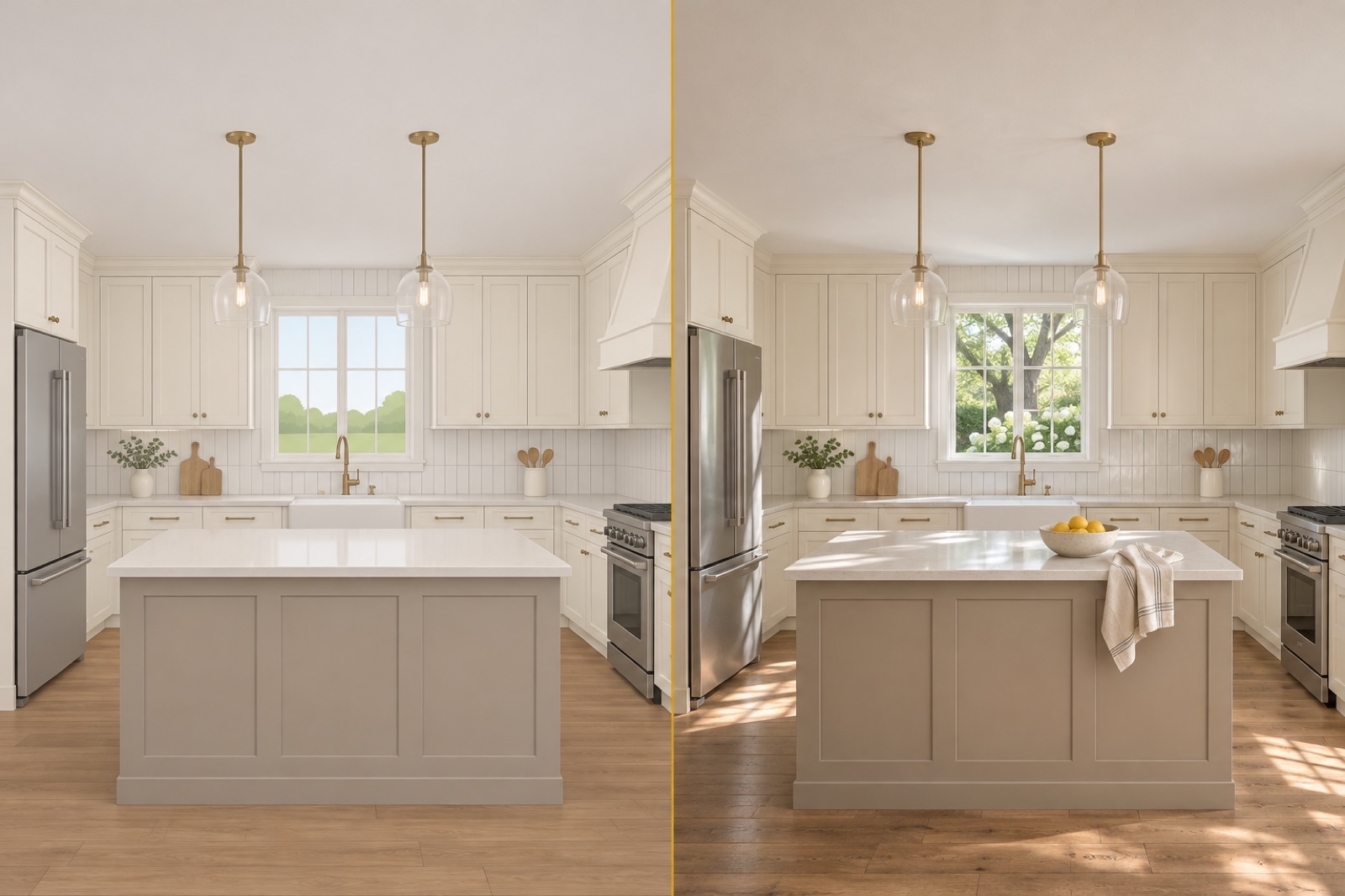
Price it. Once you approve the design, you get one price for that exact design, broken down line by line. Labor, materials, and permits are all included, and that price is locked to the design.
Lock it. The design and the price are signed together. From then on, the price changes only for two reasons: you change something, or the walls reveal something nobody could have seen. A fair contract says both in writing.
Why does this matter? Moving a sink on a screen takes a few clicks. Moving it after the pipes are in can cost thousands. When every choice is made on the 3D design first, there's very little left to change once the work begins, and that's what keeps the price where you signed it.
Rule 3: Pay only for work you can see
After the deposit, every payment is tied to a step you can check with your own eyes:
| Payment | When you pay |
|---|---|
| $1,000 or 10% (whichever is less) | After the contract is signed |
| Up to 35% | Demolition and framing are done |
| 25% | Wiring and plumbing are in, and you've checked them before the walls close |
| 30% | Cabinets, floors, tile and fixtures are in and match your 3D design |
| Final 10% | Everything is finished, inspected and under warranty |
In your contract, each payment should be written in dollars and tied to specific work, not just shown as a percentage.

Because the last 10% is held back, the contractor has a strong reason to finish the job completely.
The risk-free remodel
A small group of California contractors now works this way from day one. We call it the risk-free remodel: a legal deposit, a design and price locked before work starts, and payments tied to finished work.
| Traditional remodel | Risk-free remodel | |
|---|---|---|
| Price | A "ballpark" guess | Locked to the 3D design you approve |
| Deposit | Often 30-50% upfront | $1,000 or 10%, the legal limit |
| Payments | By calendar date | By finished work you can check |
| Final payment | When it's "basically done" | When it matches your design |
The hard part is finding these contractors. That's where we come in.

Why we started Renology
Before Renology, our team spent years working with home services companies across the US. We saw the same story again and again: good homeowners and good contractors getting stuck in bad deals, because the way remodels are sold sets both sides up to fail.
The homeowner doesn't know what the final price will be. The contractor is pricing a job they haven't fully planned. Then everyone hopes for the best.
"We don't think a remodel should be a gamble. When you can see the result and know the price before anyone picks up a hammer, remodeling becomes what it should be: exciting, not scary."
The Renology founders
So we decided to do something about it. We find the contractors who already work the risk-free way, we check them carefully, and we introduce homeowners to them.
Why homeowners use Renology
We do the checking for you.
Before we introduce a contractor, we make sure they have:
- An active California license and a clean record with the state board
- Proper insurance
- Strong reviews from past clients
- A deposit within the legal limit
- Payments tied to finished work
- A designer on the team who shows you the finished room in 3D before construction starts
Skip the calling around.
No searching, no comparing dozens of websites, no guessing who's honest. You tell us about your project once, and we bring the right contractors to you.
Your phone stays quiet.
We don't sell your details to a list of strangers. Contractors don't call you directly. We introduce you only to the matches you choose to hear from.
Compare real offers, not guesses.
You get three vetted contractors who develop the idea with you and price it, so your three prices start from the same place.

What happens next
- Tell us about your project. Answer a few short questions about what you want to remodel.
- Get matched. We introduce you to up to three vetted contractors who work the risk-free way.
- See it and price it. With the contractor you choose, you see the finished room in 3D and get a price locked to that design before construction starts.
- You choose. Pick the contractor you like best, or none at all.
No cost and no obligation.
No obligation. Contractors don't call you directly. We screen, you choose.